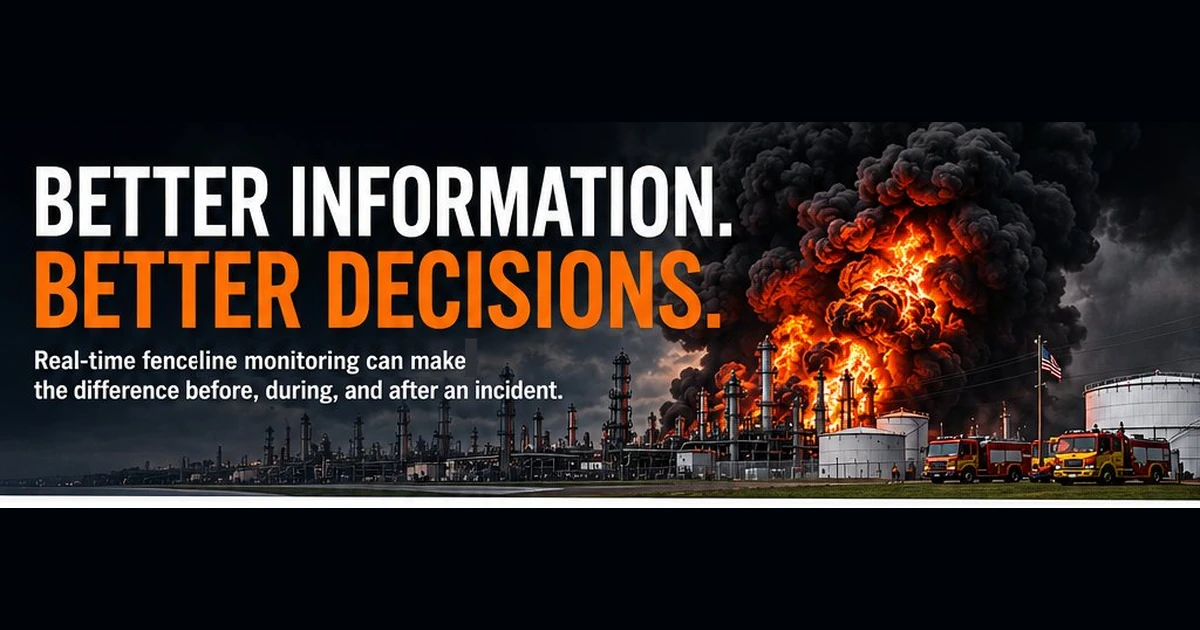
The recent chemical incidents in California and Washington State have once again demonstrated the significant risks associated with hazardous material releases. These events resulted in fatalities, injuries, large-scale evacuations, economic losses, and growing concerns regarding potential impacts on public health and the environment.
While investigations will rightly focus on the direct causes of these incidents—whether equipment failures, maintenance deficiencies, process upsets, or human error—another important question deserves equal attention:
Are we providing operators, regulators, and emergency responders with the information they need to detect abnormal conditions earlier and manage incidents more effectively?
Today, advances in environmental monitoring technology offer an opportunity to strengthen industrial safety through continuous fenceline monitoring. Technologies such as Open-Path FTIR (OP-FTIR), UV-DOAS, Tunable Diode Laser (TDL), Gas Chromatography (GC), and Cavity Ring-Down Spectroscopy (CRDS) can provide real-time information about emissions at industrial facility boundaries. When combined with meteorological measurements and dispersion modeling, these systems create a powerful environmental intelligence platform capable of identifying abnormal emissions, tracking plume movement, and supporting informed decision-making. These capabilities are especially relevant at refineries, petrochemical plants, and bulk storage terminals, where large volumes of volatile and hazardous materials are handled near surrounding communities.
The value of these capabilities becomes particularly apparent during emergency situations. In the recent California incident involving methyl methacrylate (MMA) and the Washington State event involving the release of white liquor, emergency managers faced the challenge of rapidly assessing potential impacts on nearby communities. Questions such as what was released, where the plume is moving, who may be affected, and whether residents should shelter in place or evacuate require accurate, real-time information. Continuous monitoring systems can help provide those answers when they are needed most.
However, the benefits of fenceline monitoring extend well beyond emergency response.
History has repeatedly shown that major industrial disasters are often preceded by abnormal emissions or process upsets. One of the best-known examples is the Buncefield Oil Depot disaster in the United Kingdom. Before ignition occurred, a large gasoline vapor cloud formed and spread beyond the facility boundaries. The resulting explosion became one of the largest peacetime industrial explosions in Europe. While no single technology can prevent every accident, earlier identification of abnormal emissions and plume migration may provide valuable opportunities for intervention before an event escalates.
Fenceline monitoring can also serve as an important indicator of broader operational performance. Prior to the 2019 Philadelphia Energy Solutions (PES) refinery explosion, environmental monitoring studies identified elevated benzene concentrations and recurring emission events around the facility. Although these observations were not directly linked to the specific equipment failure that caused the explosion, they highlighted operational and emissions-related challenges that warranted attention. Such findings demonstrate that environmental monitoring data can provide valuable insight into fugitive emissions, maintenance deficiencies, and process safety vulnerabilities.
Just as importantly, continuous monitoring can help strengthen public trust.
During many industrial incidents, residents report odors, eye irritation, respiratory discomfort, or other symptoms, while official communications indicate that monitoring systems have not detected significant impacts. Whether justified or not, this disconnect can quickly create a credibility gap between facilities and the communities that host them.
Advanced fenceline monitoring technologies help bridge that gap by providing transparent, chemical-specific, real-time information that can be shared with regulators, emergency responders, local authorities, and the public. Better information supports better communication, more effective emergency management, and greater confidence in decision-making.
For this reason, fenceline monitoring should be viewed through two complementary lenses.
First, it should be adopted voluntarily by industrial operators as a best practice for risk management, environmental stewardship, and operational excellence. Organizations that invest in real-time environmental intelligence demonstrate a proactive commitment to protecting employees, neighboring communities, and the environment.
Second, regulators should consider incorporating advanced monitoring capabilities into emergency preparedness and incident management frameworks for facilities handling significant quantities of hazardous materials. During major incidents, access to real-time chemical and meteorological information can significantly improve response effectiveness, exposure assessment, public communication, and protective action decisions.
The lessons from California, Washington, Philadelphia, Buncefield, and many other industrial incidents are clear:
Better information leads to better decisions.
Continuous fenceline monitoring cannot eliminate industrial risk. However, it can provide earlier warning, improve situational awareness, strengthen transparency, support emergency response, and help protect workers, communities, and the environment.
The technology exists. The question is no longer whether we can monitor. The question is whether we choose to.
Atmosfir Optics — Real-Time Environmental Intelligence for Safer Industrial Operations.